Like consonants, vowels are made by expelling air from the lungs through the (vibrating) vocal cords and into the oral cavity. Unlike the consonants, however, when we make the vowel sounds we do not close or greatly obstruct the air flow. Instead, we move the tongue into various places and raise or lower our lower jaw, and by doing so, we alter the frequency of the vibrations caused by the air flow and vocal cords. The variations in frequency are perceived as different phonemes. In General American English twelve distinct vowel phonemes can be distinguished.
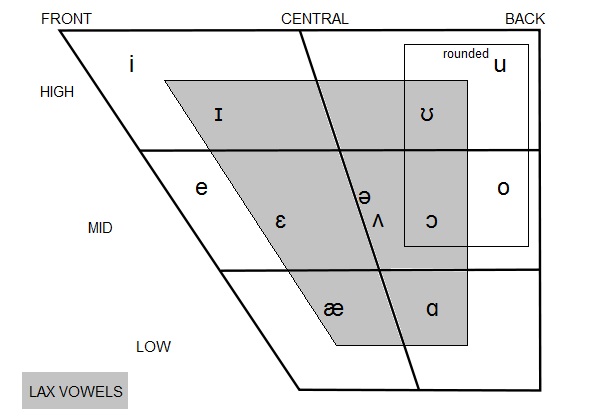
The chart represents the inside of the mouth if facing towards the left. Thus, where the chart says “front” is the front of the mouth, specifically the area just behind the teeth, the alveolar ridge. The right-hand side of the chart, which is labeled “back” is the back of the mouth, roughly where the velum, or soft palate, is. Similarly, the three sections labeled “high,” “mid,” and “low” represent the roof of the mouth down to the lower jaw. The symbols are placed at the various locations within the mouth where the tongue moves in order to make the relevant vowel sound. The symbols in the white area represent the vowels in which the tongue is fairly “tense” while saying them, while the symbols within the grayed area are made with a more relaxed tongue. Finally, the four vowel symbols within the box in the back, high, and mid area are vowels which are pronounced while the lips are “rounded.” Further explanation of this terminology will be found below.
An interactive vowel chart, with audio examples, can be found < a href=”http://www.yorku.ca/earmstro/ipa/vowels.html” target=”_blank”>here.
Distinctive Features
Vowels are distinguished by four distinctive features: height, frontness, tenseness, and roundedness. The first three of these concern tongue placement within the oral cavity, and the last concerns the shape of the lips.
Vowel Height: There are three positions, high, mid, and low, depending on whether the tongue is near the roof of the mouth (i.e., high), or near the floor of the mouth.
Frontness: There are also three positions here, front, central and back, depending on whether the tongue is pushed to the front of the mouth near the teeth or the back of the mouth. English generally distinguishes only front and back vowels.
Tenseness: Vowels can be tense or lax, depending again on the tongue. Tense and lax only applies to high and mid vowels. The low vowels do not have tense distinctions.
Roundedness: This feature describes the shape of the lips in making these sounds. In English generally the front vowels are unrounded and the back vowels (at least the mid and high ones) are rounded.
Vowel Phonemes in English
High Vowels
- front, tense, unrounded /i/. Examples: bee, beat, machine
- front, lax, unrounded /ɪ/. Examples: bit, flip
- back, tense, rounded /u/. Examples: moon, mood, rude
- back, lax, rounded /ʊ/. Examples: put, foot, book
Mid Vowels
- front, tense, unrounded /e/. Examples: bait, day, made, name
- front, lax, unrounded /ɛ/. Examples: bet, head, peck
- back, tense, rounded /o/: Examples: boat, hope, moan
- back, lax, rounded /ɔ/: Examples: bought, caught, hawk (Note: Many speakers of American English do not have this vowel as a distinct phoneme)
Low Vowels
- front, unrounded /æ/. Examples: cat, can, had
- back, unrounded /ɑ/. Examples: cot, hock, pot, bother, father. (For many American English speakers, the vowels in the words bought, caught belong here as well).
Central Vowels
- /ʌ/. This sound is a central, mid, unrounded, lax vowel. It is used for vowels in stressed syllables like cup, luck, love
- /ə/. This is the schwa, the reduced central mid vowel found in most unaccented syllables. It comprises several different vowel sounds, all found in unaccented syllables, specifically [ə], as in about, sofa, occur, nation. And a slightly higher vowel, [ɨ], as in dishes, messes, rated, raided. For the purposes of this course you can transcribe both of these as /ə/.
Diphthongs
All the above vowel sounds are monophthongs, that is, they are single vowel sounds. As such, they are distinguished from diphthongs, two vowels sounds spoken together in a single syllable. There are three phonemic diphthongs in American English. Each consists of a main vowel, followed by an offglide which is either a front or back high lax vowel.
- /aɪ/. This sound starts with /a/, a low front vowel similar to /æ/, and then continues up towards /ɪ/. Examples: rice, wife, eye
- /aʊ/. This sound also starts with /a/, but then the tongue moves up and back and the lips round, towards /ʊ/. Examples: house, brown, cow
- /ɔɪ/. This sound starts with the mid back rounded vowel /ɔ/ before moving up to the front unrounded /ɪ/. Examples: joy, boy, boil
A note on the pronunciations of monophthongs as diphthongs in American English: Most speakers of American English pronounce the simplex vowels like /e/ and /o/ as the diphthongs [eɪ] and [oʊ]. As a result, many textbooks and online resources give represent these vowels in IPA as diphthongs. In British resources /o/ is often represented as the diphthong [ɛʊ]. In this course, however, we will treat these vowels as if they were pronounced simply /e/ and /o/.
