The preceding discussion of the different approaches to linguistics should suggest to you that defining language itself is quite difficult. It meant something very different to the neogrammarians than it did to the structuralists, not to mention what it means to twenty-first-century linguists. Indeed, the central question guiding the work of many of these scholars has been “what is language,” and the definition one gives largely depends on the type of linguistics one studies. It is quite difficult to define language in a way that encompasses all varieties that exist (or have existed) and that distinguishes it from other forms of communication.
Because of this difficulty, instead of providing a simple definition, it is perhaps preferable instead to provide a list of features that all languages share. For example, in several papers published between 1959 and 1968, Charles Hockett enumerated 16 “design features” of language. Several of these can be found in different types of animal communication, about which more is being learned all the time (for example, see this article from Jan 20, referring to this academic article), but only human language have all 16.
- Vocal-auditory channel
- Broadcast transmission and directional reception
- Transitoriness
- Interchangeability
- Total Feedback
- Specialization
- Semanticity
- Arbitrariness
- Discreteness
- Displacement
- Productivity
- Traditional Transmission
- Duality of Patterning
- Reflexiveness
- Learnability
- Blending
Several of these features are especially important for studying the history of the English language.
1. Vocal-Auditory Channel. Language is produced in the vocal tract and processed by the ears. This feature is very important to keep in mind for modern English speakers because we live in such a heavily literate society. We therefore often tend to think that the written language is somehow a more “pure” or “correct” version of English, and spoken English is often described with dismissive terms such as “colloquial” or “vernacular,” as if it were a pale reflection of true, written English. But for most of the history of English, the majority of people were unable to read and write and yet were able to communicate perfectly well. All natural languages must have a vocal-auditory method of communication, but there is no necessity for a language to be written. Therefore, written forms of a language are often entirely ignored in linguistics. A necessary consequence of this is that many of the so-called “problems” that people mention when they discuss “bad English” are not actual linguistic problems. Errors of spelling, punctuation, contractions, capitalization, fonts, substitution of symbols for letters (“2” for “to”), and so on, are aspects of writing and have nothing to do with language per se.
7. Semanticity. Speech sounds in language convey specific meanings. To use Hockett’s own example, a dog’s panting produces sound and may indicate that the dog is hot, but this meaning is a side effect. The panting is a physical reaction to being hot, not an intentional communication of that hotness. A person may breath heavily to intentionally convey a certain meaning; however, it may also simply indicate that he or she is hot or has been physically exerting themselves–there is not a single specific meaning conveyed by this sound. Words, on the other hand, do convey specific meanings that are particular to those combination of sounds.
8. Arbitrariness. There is no direct connection between the auditory signal and the meaning given to it. This is perhaps the most crucial feature for studying how a language can change over time. It comprises two concepts: language is arbitrary and language is conventional. In his Course in General Linguistics Saussure presents the notion of the sign, a combination of the signifier, which is the sound in speech of a word, and the signified, the mental concept which the sound evokes. In the case of “tree,” the sound we make when we say the word is the signifier, which calls to mind the concept of a tree, which is the signified.
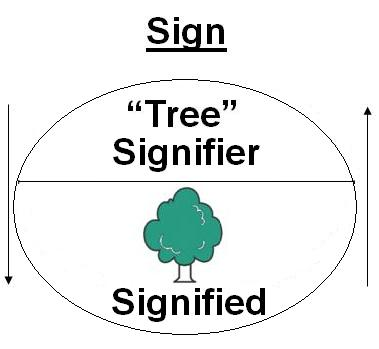
Linguistic Sign
The connection between the signifier and the signified, as Saussure stressed, is entirely arbitrary. We could use any combinations of sounds as the signifier for a tree. There is nothing in the sound pattern t-r-ee that connects it inherently to either actual, physical trees that exist in the visible world or to the mental concept of trees. So why do we use the signifier “tree” instead of some other group of sounds? Purely by convention, that is, by agreement. As a community of speakers of a language, we have all “agreed” that the sound “tree” will signify the concept of trees. We could change this and use a different sound, as long as enough speakers “agreed” to it. In fact, a thousand years ago, many English speakers used the word beam to refer to trees, but over time we have stopped using “beam” for entire trees and instead we use it for just a specific part of a tree, or a long piece of wood, or even now just any long, straight thing, such as a beam of light. At the same time we agreed that trees would be referred to by the word “tree.” Since the connection between the word “tree” and trees is arbitrary, we may decide in the future to use the word “tree” for something else and use another word for trees (consider the terms “family tree” or the “file tree” system in computers). It should be emphasized here that the term “arbitrary” as used here should not be confused with the false notion that anything can mean anything in language. As described above, it is only the connection between signified and signifier that is arbitrary, but there is a connection, one that we have agreed upon by convention.
The primary objection that can be brought up against the notions of arbitrariness and convention is onomatopoeia, words whose sound pattern seems to mimic the actual sound it refers to. Onomatopoeia suggests that there is an intrinsic, non-arbitrary connection between a sound and the word that describes it. Such words rarely hold up to scrutiny, however. First, many of the words which speakers of one language consider an accurate phonic representation of a sound turn out to vary widely across languages. A good example is the crow of a rooster. For English speakers, roosters say “cock-a-doodle-do,” while for Spanish speakers they say ‘kikiriki.” Roosters do not actually crow differently in different countries, but our perceptions of them, or at least our attempts to mimic them, fall into the sound patterns of our own particular language. Furthermore, supposedly onomatopoeic words change over time, following the same sound changes that other words undergo — if they truly represented the sound they signify, then they would presumably not change. For example, some might think that the word “fart” is an onomatopoeic representation of a sound, but this word in fact goes back to the Proto-Indo-European root *perd-. This root may itself be an onomatopoeia, but its descendants in multiple modern languages all sound quite different. If there was an intrinsic connection between the word and the sound, it was broken when the word changed across time.
9. Discreteness. Each unit of communication can be separated and is unmistakable. When someone says the word pat we can separate it into three discrete or distinct segments, p, a, and t. These individual segments are recognizably distinct from other segments. They can also be used in different combinations and have unrelated meanings, such as tap or apt.
11. Productivity. Language can create an infinite number of new utterances with new meanings by combining already existing signs. In fact, every day each of us probably produces or comes across utterances that have never been made before in human history. Note that the ability to produce such new utterances and also to understand them means that language has a grammatical patterning or system. If there was no underlying grammatical system over which we could lay our signs in an understandable order, then we would only be able to reproduce sentences that we had previously memorized.
12. Traditional Transmission. Language is learned in social groups. We learn English because we grow up and are surrounded by other speakers of English. Furthermore, the variety of English we learn is determined by the social group in which we are speaking. Recognition of this fact will explain much of the “non-linguistic” material that we will cover in this course. For example, we have a vast amount of words in English that we borrowed from Scandinavian languages, due in large part to the Viking invasions of England in the ninth century. We also have a large amount of French words from the Norman invasion of the 11th century. Language is socially transmitted, not genetically transmitted.
13. Duality of Patterning. The infinite number of new meanings is created by a finite number of sound components. The continuous stream of speech that we hear can be divided into discrete segments (see discreteness above). These discrete segments are finite in number (in English we only use about 39 or 40 individual sounds) and on their own are meaningless, yet they can be combined in numerous ways to create an infinite number of meaningful statements.
These 7 features (out of the 16 total) are the most important for understanding how language works and how it can change. If we had to construct a definition out of them, we could say something like “Language is a conventional, socially-transmitted system of discrete vocal sounds which are combined to create an infinite number of signs used for human communication.”
