The information on this page is largely beyond the scope of this class, and goes into the field of acoustic phonetics. I give it here for three purposes:
- to explain in somewhat more detail how phonemes are made
- to explain how phonemes are perceived
- to explain one process by which phonemes can change
The second and third of these are the most important, but they necessitate some technical details in the explanation of the first
1. Phonetics (how phonemes are made)
Vocal sounds are made by expelling air from the lungs while vibrating the vocal cords. These vibrations set up a certain frequency within the oral cavity, which acts as a resonance chamber. We then vary this frequency in two primary ways. There is a vertical variation (F1), which we make by raising or lowering the lower jaw. (Think of how high the jaw is (and therefore how closed the oral cavity is) when you say the vowel in a word like “leak,” and how low and open the oral cavity is in a word like “lock”). There is also a horizontal variation (F2), which we create by moving the tongue either towards the front of the mouth or the back. These two frequencies, called formants, act together to make sound that we perceive as different vowel phonemes.
These frequencies can then be plotted on a graph, with F1 on a vertical axis and F2 on a horizontal one:
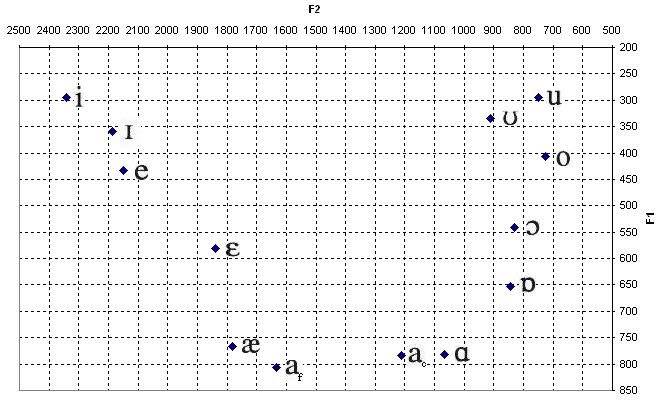
If you examine this chart briefly, you can see that the symbol /i/ (representing the vowel sound in words like “heed” or “fleece”) is at the vertical axis at about 290 Hz and the horizontal axis at about 2350 Hz. Its position here, in the upper left corner of the graph is the same as it was on the vowel chart given in section 2.4. This means that to say this vowel, the tongue must be at the top of the mouth, almost or actually touching the rough of the mouth, and the tongue must be pushed forward towards the front of the mouth, so that it is just behind the teeth. If we move the tongue slightly back and open the mouth slightly so that the tongue is a little lower, we will change the resonating frequencies of the air so that the two formants vibrate at about 360 Hz (F1) and 2190 Hz (F2), producing the sound /ɪ/.
2. How phonemes are perceived
The chart above represents the frequencies produced when we make different vowel phonemes, but it says nothing about how these phonemes are perceived by the auditor. This is important because phonemes are conceptually based. In other words, phonemes are not produced by vocal tracts. When someone makes a sound with their mouth, they are making just that, a sound, and only that. It is the auditor who perceives the sound and categorizes it as a particular phoneme. So what the chart above is really saying is that when a person makes a sound with the two formants resonating at 290 Hz and 2350 Hz, a speaker who hears it will categorize it as the phoneme /i/. The question now becomes what about when a person makes a sound with the two formants resonating at 300 Hz and 2300 Hz. Will this sound also be perceived as /i/? What if it is at 350 Hz and 2200 Hz? This sound is getting somewhat close to the point labeled /ɪ/. So where exactly is the cut off between the perception of one phoneme and another? The answer to this question depends largely on the language or dialect of the auditor.
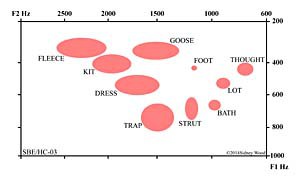
Look at the following chart of the vowels as pronounced by a speaker from southern England. It gives ranges rather than specific points, suggesting that any sound with an F1 range of about 250-375 Hz and an F2 range of about 2000-2600 Hz will be perceived as the phoneme /i/ (as pronounced in the word “fleece”). This is quite a large range. We have similarly large ranges for most of the front vowels, while the back vowels have a smaller range of accepted frequencies. We can also see in this chart how close some vowel phonemes are to others, while some are further apart.
3. How phonemes can change
Imagine a community of speakers who produce the phoneme /i/ with the ranges as given in the chart above. The range for F1 is from about 250 Hz to 375 Hz and for F2 from about 2000 Hz to 2600 Hz. Perhaps most speakers form /i/ with frequencies in the middle of the accepted range, but a minority of speakers pronounce the vowel with frequencies plotted at the edge of the range. These differences would be considered non-meaningful by speakers in the community, who may in fact not even notice the difference.
Then more and more people begin to pronounce the /i/ phoneme with frequencies that can be plotted near the right-hand edge of the accepted range, say at about 350 Hz and 2000 Hz. If this eventually becomes the more common pronunciation of /i/, then the oval denoting the range might shift to the right and down a little, so that the new, more popular pronunciation is in the center of the oval rather than on the edge. There are many reasons why this shift might happen. Perhaps it is slightly easier physically not to push the tongue so far forward and so far up, especially when it is not necessary to move it that far to still be within the accepted range. Perhaps the few people in the community who pronounce the sound with the less popular pronunciation become more successful financially or politically so that others in the community, either consciously or subconsciously, begin to mimic their way of talking. Perhaps a large number of outsiders move into the community whose version of this phoneme is already at the edge of the accepted range influence others to imitate them. Changes like these, whether they happen quickly or over several generations, can cause the acceptable range of a phoneme pronunciation to shift frequencies.
The problem with this shift of the /i/ phoneme down and to the right is that the frequencies there are used for the phoneme /ɪ/, and the important point about phonemes is that they are meaningfully distinct from each other. Thus, one of three things might happen.
- The range of the phoneme /ɪ/ holds its place and effectively halts the movement of /i/, stopping the vowel shift from taking place
- The two phonemes could merge, so that the phonemes /ɪ/ and /i/ became the same sound to speakers in the community who could no longer distinguish between them. An example of a vowel merger in American English is seen in those people who no longer distinguish the phoneme /ɔ/ in words like “caught” and “bought” with the vowel /ɑ/ in words like “cot” and “bot.” If these four words rhyme to you, then you have this merger.
- The movement of the range for /i/ can cause the range for /ɪ/ to move, so that a distinction is maintained for the two sounds. This type of shift can cause a chain reaction, in which one phoneme moves, causing another to move to keep away, causing yet another to move, and so on, so that effectively all the vowels move their accepted ranges. This has happened numerous times in English over the last 1500 years. The most famous example is known as the Great Vowel Shift, in which all the long vowels moved places, but several smaller chain shifts are occurring throughout American English today (e.g., the Northern Cities Shift, the California Shift, the Southern Shift), all of which will be covered later in the semester.
